The Law of Solid Ground: Trust Is the Foundation of Leadership
Updated · Untitled Leader Editorial Team
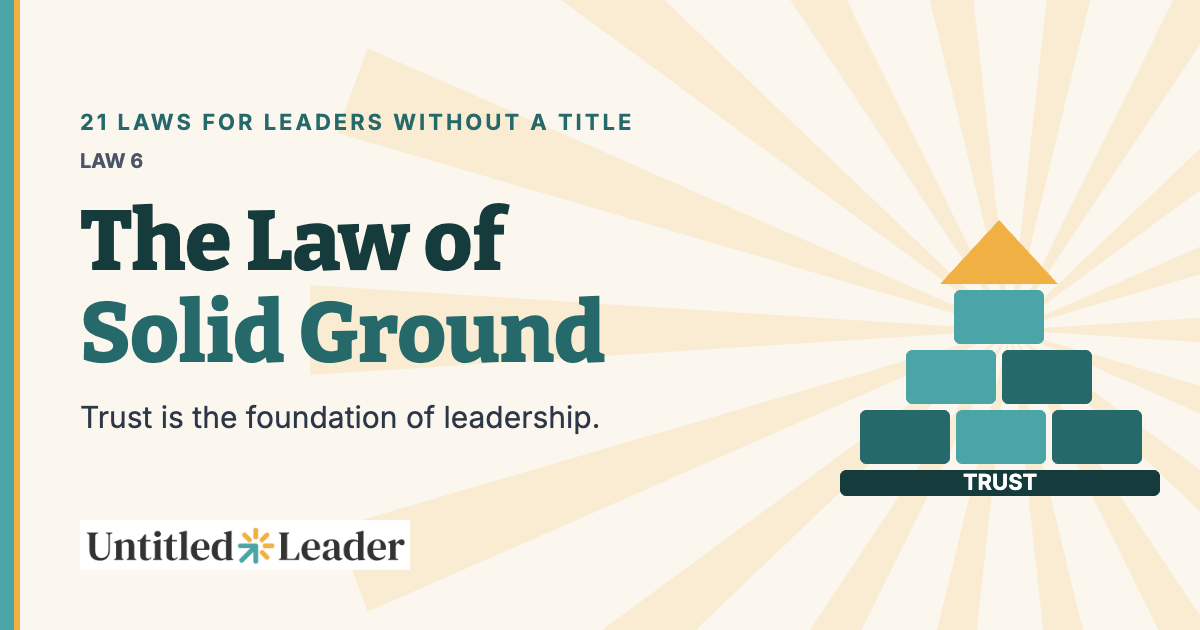
Quick answer: The Law of Solid Ground says trust is the foundation of leadership. People won’t follow someone they don’t trust, no matter how talented or well-titled they are. Leaders build trust through competence, connection and character, and the most important of those is character. Jump to the exercise.
This is part 6 of 21 Laws for Leaders Without a Title, our series applying John C. Maxwell’s 21 Irrefutable Laws of Leadership to team captains and new team leads. Start with part 1: the Law of the Lid.
What the law says
Maxwell compares trust to the foundation of a building. You can’t see it, but everything else rests on it. When trust cracks, everything built on top starts to wobble: people stop believing the plan, stop speaking up and stop giving their best.
He names three things that build trust: competence (you’re good at what you do), connection (you care about people) and character (you’re honest and consistent). Of the three, character matters most. People will forgive an honest mistake. They don’t easily forgive a broken promise or a lie.
What it looks like for a team captain
Ryan, the baseball team’s captain, told the team he’d hold everyone to the same standard on missed practices. Then his best friend skipped two practices, and Ryan said nothing. Teammates noticed. For the next month, every time Ryan called someone out, it landed flat.
Ryan rebuilt trust by owning it in front of the team, having the conversation with his friend and applying the standard evenly from then on. It took weeks to earn back what one shortcut cost.
What it looks like for a new team lead
Elena is new to leading her team. In her first week she promised to look into a scheduling problem that had frustrated everyone for months. She followed up within days with a fix and an honest note about what she couldn’t change yet.
That one kept promise did more for her credibility than any first-week speech. The team started bringing her problems early, because they believed she’d act on them.
How to build solid ground
- Keep small promises. Trust is built in tiny deposits: showing up on time, following up when you said you would, remembering what someone told you.
- Be the same in private and in public. Don’t say one thing to the team and another behind someone’s back. People find out.
- Apply standards evenly. Nothing breaks trust faster than different rules for friends or favorites.
- Admit mistakes quickly. Owning a mistake builds more trust than hiding it ever could.
- Get good at your role. Character comes first, but competence matters too. People trust leaders who know what they’re doing.
Common mistakes
- Thinking one big moment builds trust. It’s built slowly and lost quickly.
- Taking a shortcut “just this once.” Teams remember the exception more than the rule.
- Defending instead of owning. Explaining away a broken promise spends even more trust.
Try this
The trust audit (10 minutes, on your own).
- List every promise or commitment you’ve made to your team in the last month, big or small.
- Mark each one: kept, broken or still open.
- For any broken ones, decide how you’ll own it: a quick, honest acknowledgment to the person or team.
- For open ones, pick a date to finish each.
- Going forward, write down every commitment you make for two weeks. Notice how many you make, and whether you should make fewer.
Say this
“I told you I’d handle that, and I didn’t. That’s on me. Here’s what I’m doing about it, and here’s when it’ll be done.”
Talk about it
- Who do you trust most on this team, and why?
- Have we ever had different rules for different people? How did it affect us?
- What’s one small thing each of us could do this week to build trust?
As an Amazon Associate, Untitled Leader earns from qualifying purchases. Some other links here are affiliate or referral links. They cost you nothing extra, and we only recommend what fits.
Go deeper
The 21 Irrefutable Laws of Leadership
The Law of Solid Ground is chapter six. Pair it with the trust audit above.
Also good: The Speed of Trust by Stephen M.R. Covey, a full guide to building trust as a skill. See it on Amazon
In the series: Part 1: Lid · Part 2: Influence · Part 3: Process · Part 4: Navigation · Part 5: Addition. Next: part 7: the Law of Respect.
Keep going
- Brené Brown: courage, vulnerability and hard conversations
- Kouzes and Posner: credibility and the five practices
- When a friend keeps arriving late
- The Law of Addition: leaders add value by serving others
- Free printable: Get the 21 Laws Checklist (plus The Captain’s Pyramid Checklist)
- Untitled Leadership: how to lead before anyone gives you the title
- New to leading a team? Get the free First 30 Days starter kit
Leading a team?
Get the words for your next team conversation.
Free scripts and ten-minute exercises for new team leads, captains and student leaders.